Conversations with artists and makers about materials, gestures, places and the paths that shape their practice.
PERSONAL PERSPECTIVE
Claudi Casanovas
ORACLE, a Material to Decipher
Rock, organism or ritual object?
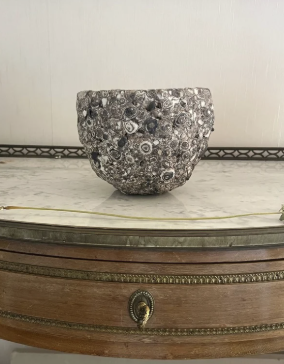
At Le Don du Fel, my gaze settled on this small work by Claudi Casanovas, from the Oracle series, created in 2020.
Its form retains the memory of the pot, one of ceramics’ oldest expressions. Yet its surface takes us elsewhere: towards volcanic rock, a lunar fragment, an organism observed under a microscope. Eye-like structures recur across the material, like so many cells or tiny eyes. At this small scale, an entire landscape seems to unfold.
I chose this piece for its dense, mysterious presence. Then, through Le Don du Fel, I was able to share my observations with the artist. His response opened up another reading: that of a material threaded with signs, poised between remnant and writing.
FIRE, CRACKS AND SIGNS
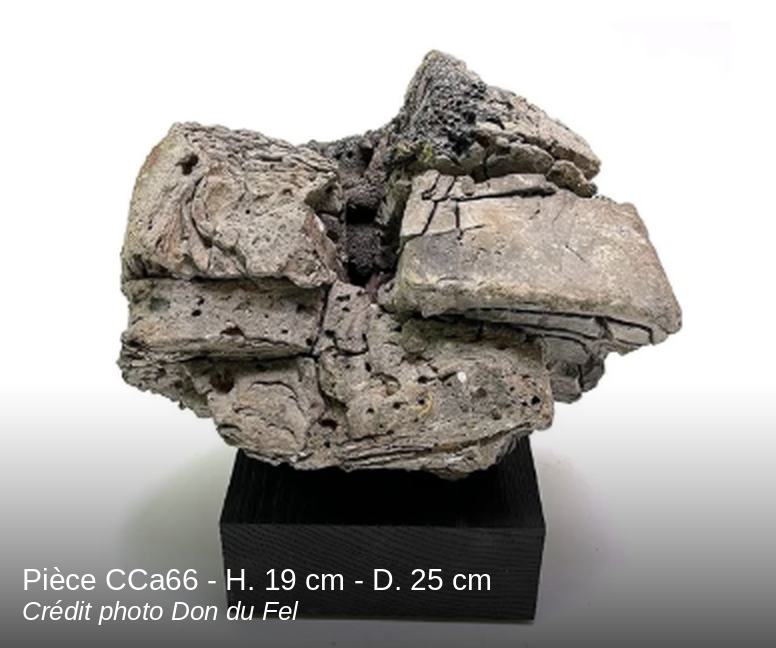
Claudi Casanovas explains that the Oracle series draws inspiration from an ancient Chinese divinatory practice involving tortoise shells. Cracks produced by fire were interpreted, and inscriptions accompanied these practices.
In the notes he shared with me, the artist connects this history with the origins of Chinese writing. He also evokes birds’ footprints in mud, as a possible image of the passage from the natural world to the sign. A trace becomes legible; matter seems capable of conveying something.
This reference shifts my perception of the work. The marks I saw as cells or tiny eyes can also be viewed as elements of a language to which we have no key.
Remnants full of stories
For Claudi Casanovas, the Oracle pieces are remains, remnants: what survives of an object that reaches us incomplete, yet laden with stories.
I had seen them as votive vessels, as though unearthed from an archaeological site. His words echo this intuition while broadening it. The fragment leaves room for what is missing: its function, its context, the gestures of which it might once have been part. It invites us to imagine without allowing us to reach a conclusion.
The artist then poses a question: could these remnants suggest the origins of a new language? Here, the title Oracle finds its full resonance. It places us before something to question, to listen to, to decipher.
EROSION, BETWEEN LAND AND WATER
The volcanic island of El Hierro, in the Canary Islands, also enters this narrative, although Claudi specifies that its influence on the series is indirect.
He remembers nights when the tides sent enormous rocks rolling noisily along the beaches. Perhaps it is this erosive force that he recognises in Oracle: pieces deeply worn, yet still present.
My evocation of volcanic rock thus finds an echo in an experience of movement and time. The material holds less the image of a particular landscape than the memory of the forces that transform it.
The tortoise itself occupies a distinctive place in his thinking. Claudi describes it as an enigmatic, mysterious creature, between land and water. He adds: “Perhaps I identify with a tortoise myself.” This personal reflection gives the series an intimate dimension, beyond its reference to ancient practices.
I return, then, to the small piece I chose at Le Don du Fel. For me, it retains its memory of the pot, its cells, its landscape. But it now also carries the possibility of writing and a history of erosion.
A small piece, yet already a whole world to decipher.
Sophie Grenier — Terre & Lumière
About Claudi Casanovas
Born: Barcelona, 1956
Training: Ceramics in Olot
Practice: Sculptural works through experimentation with clay and fire
Recognition: First prize, International Ceramics Competition of Mino, Japan, 1992